Which online casino game is best for UK players?

Verdict up front: there is no single best online casino game for everyone. Preference depends on what a player values most — entertainment, house edge, pace, or social interaction. The term "casino games" in Great Britain normally covers slots, roulette, blackjack, baccarat and live dealer games, and each group answers a different need.
Players who chase pure thrills will usually prefer slots. Players who want decision-making and a chance to reduce the house edge will pick blackjack or video poker. Those who enjoy spectacle and watching a table game play out often choose live dealer roulette or baccarat.
A practical place to try a range of options without committing to one style is slotclover casino, but this article remains a general guide for regulated GB play rather than a brand endorsement. The point is to test formats and stakes within the UK regulatory framework before settling on a favourite.
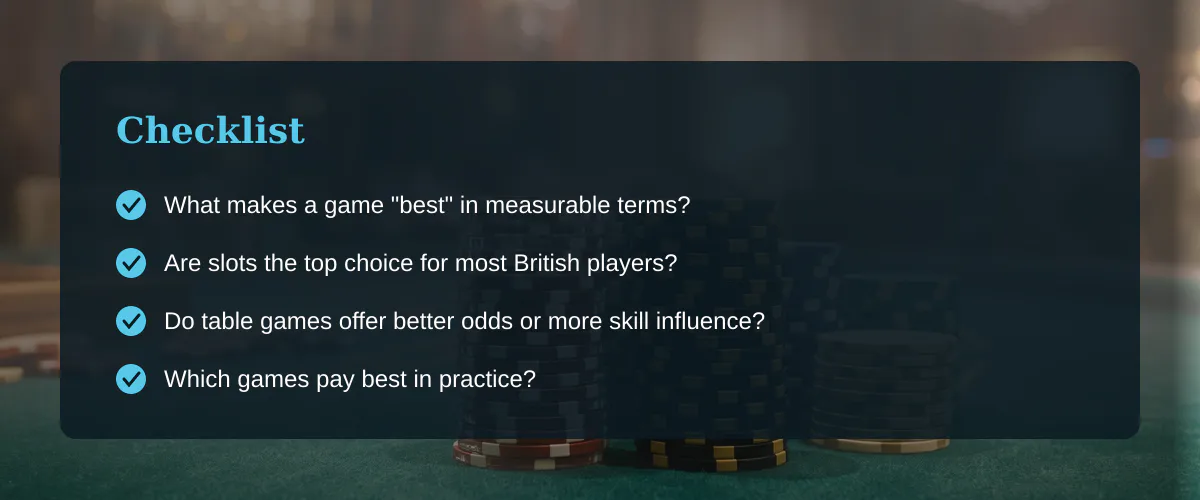
What makes a game "best" in measurable terms?
Verdict first: the best game for measurable value combines a high return-to-player (RTP) with sustainable stake sizing. RTP is the statistical long-term return the game offers and gives a baseline for comparing house advantage. A high RTP does not guarantee wins but lowers the expected loss per pound staked.
Skills and strategy matter. Blackjack and video poker offer decision points where player choices can change the expected return. Slots and roulette are mostly luck-driven, so RTP and volatility govern outcomes. Volatility dictates the pattern of wins: low volatility yields frequent small wins; high volatility delivers rare big wins. Players should balance RTP against volatility to match bankroll and goals.
Practical value also includes session length and entertainment per minute. Fast, high-volatility slots can burn a bankroll quickly while slower table games or low-volatility slots stretch playtime for the same outlay. The best measurable pick depends on whether the player prefers longer sessions or the chance of a sudden win.
Are slots the top choice for most British players?
Verdict: slots are the most played online casino game because they are simple, varied and widely marketed. They dominate player traffic, especially around football and horse-racing seasons when casual bets spike. The range spans classic three-reel games, modern video slots, and licensed titles with progressive jackpots.
Regulatory change has reshaped slots in Great Britain. A maximum stake cap exists: £2 per spin for 18–24-year-olds and £5 per spin for adults aged 25 and over. That changes how high-volatility slots perform for different age groups and narrows extreme risk for younger players. Operators must also offer tools such as deposit limits, time-outs and reality checks to help manage play.
Slots are good for casual entertainment and fast wins, but they provide little scope for skill to affect outcomes. Players should check RTP and volatility before choosing a slot and use the operator’s safer-gambling tools to set affordable stakes.
Do table games offer better odds or more skill influence?
Verdict: table games generally offer lower house edges and scope for skill, making them the best choice for players who want to influence outcomes. Blackjack, when played with correct basic strategy, reduces the house edge significantly compared with most slots. Baccarat and roulette have predictable house edges that experienced bettors can navigate.
Skill reduces variance over time, but it does not eliminate the house advantage unless the player uses advanced legal techniques. Live dealer tables replicate the land-based experience and slow the game pace, which helps bankroll management. Players should learn basic strategy charts and game-specific rules before staking significant sums.
Table games suit players focused on edge management and longer sessions. They reward study and discipline more than the instant thrills of modern slots.
Which games pay best in practice?
Verdict: the games that pay best are those with the highest RTP and the lowest effective volatility for the player’s stake. Many online table games present RTPs above 98% under the right strategy. Some video poker variants also reach this band when played optimally.
Slots vary widely; some popular online slots list RTPs in the mid-90s, others edge above 96–97%. Progressive jackpot slots can have lower RTP for the base game but offer life-changing jackpot potential; that trade-off is intentional. Players aiming for maximised expected return should target games with documented RTPs and play them at stakes that match volatility.
RTP is a long-term metric and does not predict short sessions. The best practical approach is to use RTP as a selection filter, then control bet size and session time to manage variance.
Which payment methods and limits matter for choosing games?
Verdict: the best payment method is the one that keeps play affordable and withdrawal times acceptable. Debit cards, PayPal, Apple Pay and Paysafecard are common options in GB and suit different needs for speed and control. Credit cards have been banned for gambling transactions since 2020 and must not be used.
Operators must perform identity and age checks under anti-money-laundering and safer-gambling rules. Affordability checks may appear for large or regular deposits. GamStop self-exclusion applies across operators and should be used by anyone who needs a break or full exclusion from online casino access.
| Payment method |
Typical processing time |
Notes for GB players |
| Debit card |
Deposits instant, withdrawals 1–5 working days |
Most used method; credit cards are prohibited for gambling |
| PayPal |
Deposits and withdrawals often instant |
Fast and widely accepted; subject to operator checks |
| Apple Pay |
Deposits instant |
Convenient on mobile devices; withdrawals use bank rails |
| Paysafecard (prepaid) |
Deposits instant |
Useful for budgeting; withdrawals require linked bank or e-wallet |
| Bank transfer |
Withdrawals 1–5 working days |
Good for larger amounts; slower but traceable |
Players should inspect an operator’s minimum and maximum withdrawal limits and processing times before playing. Limits and verification procedures can slow access to winnings if documents are not ready, so verifying identity early simplifies later withdrawals.
How should a UK player choose a game while staying compliant and safe?
Verdict: choose games that fit the bankroll and use regulatory safeguards proactively. The Gambling Act 2005 and the point-of-consumption rules from the Gambling (Licensing and Advertising) Act 2014 mean operators must hold a UK gambling licence to serve GB customers, enforce age checks, and provide self-exclusion. That legal baseline should be non-negotiable when picking where to play.
Set deposit limits and time-outs before chasing wins. Use reality checks and session timers to avoid accidental overspending. GamStop is the national self-exclusion scheme for online gambling in Great Britain; it is an effective tool for players who need total site exclusion across multiple operators. Operators must provide safer-gambling tools and carry out customer identity checks, so use those features to keep play affordable.
Tax treatment favours players. Winnings are generally not taxed as income in the UK while operators pay sector duties. Remote Gaming Duty applies at 21% on an operator’s remote gaming profits and VAT on most gambling is 0%, which shifts the tax burden to the business rather than the player.
The Gambling Commission runs an official site where players can check licences and find guidance on safer gambling, complaint routes and enforcement actions. The page explains which operators hold a UK licence and what protections that licence requires: Gambling Commission.
What practical steps end the search for a favourite game?
Verdict: test sensibly, learn quickly, and then stick to rules that preserve the bankroll. Start with low stakes and trial sessions. If a player prefers the social pace and decision complexity of table games, devote study time to strategy charts. If the attraction is entertainment and brand tie-ins, try varied slots but set strict deposit and loss limits first.
Keep records of wins and losses to assess whether a game is delivering value relative to time spent. Affordability checks may be prompted by operators; treat them as a tool not an annoyance. GamStop and provider limits are there to protect and should be used if play feels uncontrollable.
Finally, pick a licensed operator. A UK gambling licence is the baseline assurance that the operator follows age, identity and self-exclusion rules. Licensing does not eliminate risk but ensures customers have recourse and that operators contribute to safer gambling measures and taxes appropriate to the sector.