Understanding the mechanics of high-value deposit incentives in the UK

The landscape of online gambling in Great Britain operates under a strict regulatory framework designed to protect consumers while allowing for commercial competition. A common promotional tool used by operators is the deposit bonus, where additional funds are credited to a player's account upon making a financial commitment. The term 500 deposit bonus casino often appears in search queries, reflecting interest in high-value welcome offers that match or exceed substantial initial deposits. Such incentives require careful scrutiny because their utility depends entirely on the attached terms and conditions rather than the headline figure alone.
Operators licensed by the UK Gambling Commission must adhere to specific rules regarding transparency and fairness. These regulations ensure that players can make informed decisions about whether a particular offer suits their playing style and budget. The presence of a large bonus amount does not automatically imply better value, as wagering requirements and game restrictions can significantly alter the effective worth of the promotion. Understanding these mechanics is essential for any participant in the market.
Recent regulatory changes have further tightened the environment for bonus offers. Since January 2026, new caps on wagering requirements have been enforced to prevent excessive barriers to withdrawing bonus funds. This shift has altered how operators structure their welcome packages, moving away from complex multi-layered incentives toward simpler, more transparent models. Players seeking high-value bonuses must now evaluate offers within this constrained but clearer regulatory context. For those exploring various options, platforms like hadesbet provide examples of how modern operators present their incentive structures within legal boundaries.
Regulatory framework for bonus offers
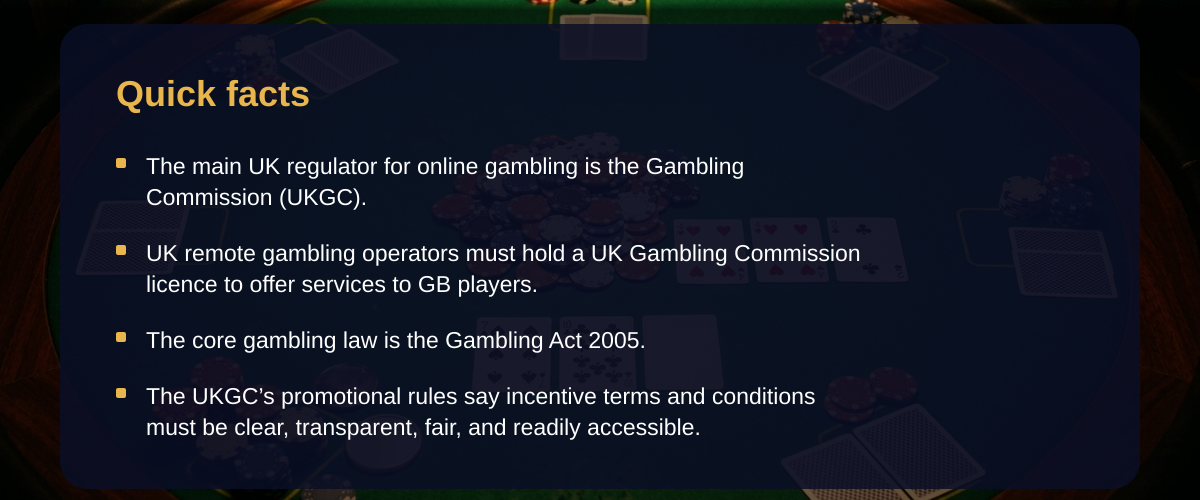
The primary authority governing online gambling in the United Kingdom is the UK Gambling Commission. This body enforces the Gambling Act 2005, which sets the legal foundation for all remote gambling activities. Operators must hold a valid licence from the Commission to offer services to players in Great Britain. Failure to comply with licensing conditions can result in severe penalties, including fines and licence revocation. The Commission’s role extends beyond mere licensing to active monitoring of operational practices.
Promotional rules issued by the UKGC mandate that all incentive terms must be clear, transparent, fair, and readily accessible. This requirement prevents operators from hiding restrictive clauses in fine print. Players must be able to understand exactly what is required of them to unlock and withdraw bonus funds. The Commission defines a wagering requirement as the number of times a customer must wager to make bonus funds withdrawable. This definition provides a standard metric for comparing different offers across the market.
Affordability checks and self-exclusion mechanisms form part of the broader consumer protection strategy. The national self-exclusion scheme, GamStop, allows individuals to block access to all licensed gambling sites for a chosen period. Operators must integrate with this system and respect exclusion requests immediately. Frictionless affordability checks are triggered when a player’s net deposit exceeds £150 over a 30-day period.
Wagering requirements and recent caps

The most critical factor in evaluating any deposit bonus is the wagering requirement. Historically, these requirements could reach levels that made withdrawal nearly impossible for average players. Regulatory intervention has addressed this issue directly. Since 19 January 2026, UK-licensed operators are prohibited from applying bonus wagering requirements above 10x the bonus amount. This cap applies specifically to bonus funds, not to the player’s own deposited cash. The distinction ensures that real money remains accessible while limiting the burden associated with promotional credits.
To illustrate the impact of this cap, consider a scenario involving a £50 bonus. Under the new rules, the total wagering required before withdrawal is £500. This figure is derived by multiplying the bonus amount by the maximum allowed multiplier. For a larger incentive, such as a £200 bonus, the required wagering amounts to £2,000. These calculations provide a concrete basis for assessing the effort needed to convert bonus funds into withdrawable cash. The previous practice of imposing 40x or 50x requirements has been eliminated for licensed operators.
The 10x limit represents a significant reduction in the barrier to entry for bonus utilization. It aligns the UK market with higher standards of consumer fairness. Operators must adjust their mathematical models to remain profitable while adhering to this constraint. This often results in lower bonus percentages or stricter eligibility criteria for high-value offers. Players benefit from greater clarity and a higher probability of successfully meeting the conditions. The playthrough requirement, a synonym for wagering requirement, is now a more manageable hurdle for most participants.
Structure of high-value incentives
A 500 deposit bonus typically refers to an offer where the operator matches a substantial initial deposit, potentially up to £500 or more. However, the structure of such incentives has changed due to another regulatory update. Since 19 January 2026, operators must not include more than one type of gambling product in a single incentive. This rule prevents the bundling of slots, table games, and sports betting into a single bonus package. Each product category must have its own distinct offer if multiple incentives are provided.
This separation simplifies the user experience but may reduce the perceived versatility of a single welcome package. Players interested in both slots and live dealer games must now navigate separate terms for each. The restriction ensures that wagering contributions are clearly defined for each product type. It also prevents operators from using low-contribution games to inflate wagering progress artificially. Transparency is enhanced as players know exactly which games count toward fulfilling the requirement for a specific bonus.
High-value bonuses often come with tiered release mechanisms. Instead of crediting the full amount immediately, operators may release funds in chunks as wagering milestones are met. This approach mitigates risk for the operator and encourages sustained engagement from the player. The terms must clearly state the release schedule and any associated conditions. Players should verify whether the bonus is credited as cash or as restricted bonus funds. Only bonus funds are subject to the 10x wagering cap, while real cash deposits remain free from such constraints.
Payment methods and transaction limits
Funding a casino account in the United Kingdom involves specific restrictions on payment methods. Credit cards are banned for gambling transactions, a measure introduced to prevent debt-fuelled gambling. Players must use alternative methods such as debit cards, PayPal, Apple Pay, or Paysafecard. These options provide immediate fund transfers and are widely accepted by licensed operators. The choice of payment method can influence the speed of withdrawals and the eligibility for certain bonuses.
Debit cards remain the most dominant payment method due to their ubiquity and ease of use. Digital wallets like PayPal and Apple Pay offer an additional layer of privacy and speed. Paysafecard provides a prepaid option for those who wish to control their spending strictly. Each method has its own processing times and potential fees, although many operators absorb these costs to remain competitive. Players should check the specific terms related to their chosen payment method before making a deposit.
Transaction limits may apply depending on the operator and the player’s verification status. Frictionless checks at the £150 net deposit threshold may trigger additional scrutiny. Higher deposits might require source of wealth documentation. This process is part of the operator’s duty to prevent money laundering and protect vulnerable players. While it may seem cumbersome, it serves a vital regulatory function. Players should ensure their accounts are fully verified to avoid delays in processing large deposits or withdrawals.
| Payment Method |
Type |
Typical Processing Time |
Eligibility for Bonus |
| Visa Debit |
Card |
Instant |
Yes |
| PayPal |
Digital Wallet |
Instant |
Yes |
| Apple Pay |
Digital Wallet |
Instant |
Yes |
| Paysafecard |
Prepaid Voucher |
Instant |
Yes |
| Bank Transfer |
Direct Bank |
1-3 Days |
Varies |
Game restrictions and stake limits
Bonus funds are rarely usable across all games without restriction. Operators typically assign contribution weights to different game types. Slots often contribute 100% toward wagering requirements, while table games like blackjack or roulette may contribute significantly less or nothing at all. This differentiation reflects the varying house edges associated with each game. Players must read the terms to identify which games are eligible for bonus play.
Stake limits apply to online slot games in Great Britain. For players aged 25 and over, the maximum stake is £5 per spin. For those aged 18 to 24, the limit is reduced to £2 per spin. These limits apply regardless of whether real money or bonus funds are being used. Exceeding these stakes can result in the forfeiture of bonus funds and any associated winnings. Operators implement technical controls to enforce these limits automatically.
The interaction between stake limits and wagering requirements affects the speed at which a player can clear a bonus. With a £500 wagering requirement on a £50 bonus, a player betting £5 per spin would need 100 spins to meet the requirement theoretically. However, variance means the actual number of spins will vary. Players should manage their bankroll carefully to ensure they do not exhaust their funds before meeting the wagering condition. The £2 limit for younger players extends this process, requiring more spins to achieve the same turnover.
Withdrawal rights and fund accessibility
A crucial consumer protection rule mandates that players must be allowed to withdraw their deposit balance at any time. This right exists even if a bonus is pending or active. Operators cannot lock real money funds behind bonus wagering requirements. If a player chooses to withdraw their deposit, the associated bonus and any winnings generated from it are typically forfeited. This trade-off allows players to maintain control over their own money.
The ability to withdraw deposits provides a safety valve for players who feel they are no longer comfortable with the bonus terms. It prevents situations where players feel trapped into playing through unreasonable conditions to access their own cash. Operators must process withdrawal requests promptly, subject to standard security checks. Delays in withdrawal processing can indicate operational issues and should be reported to the UKGC if persistent.
Winnings from bonus funds become withdrawable only after the wagering requirement is met. Until then, they remain part of the bonus balance. Players should track their progress toward meeting the requirement through their account dashboard. Most licensed operators provide a clear indicator of remaining wagering. This transparency helps players make informed decisions about continuing play or requesting a withdrawal of their deposit.
Tax implications and financial considerations
In the United Kingdom, gambling winnings are generally not taxed for individual players. The responsibility for paying gambling duty lies with the operators, not the bettors. This policy simplifies the financial outcome for players, as the amount won is the amount received. There is no need to declare gambling income on tax returns for most individuals. This stands in contrast to some other jurisdictions where gambling winnings are considered taxable income.
The absence of tax on winnings enhances the value of any bonus or profit generated. A £500 win remains £500 in the player’s pocket. This clarity supports the notion of gambling as a form of entertainment rather than a professional income source. Players should still manage their finances responsibly, treating gambling expenditure as a cost of leisure. The tax-free status does not mitigate the risk of loss inherent in gambling activities.
Financial planning for gambling should include setting strict budgets. The availability of high-value bonuses should not encourage players to deposit more than they can afford to lose. Affordability checks serve as a backstop, but personal responsibility remains paramount. Players should view bonuses as a way to extend playtime rather than a guaranteed path to profit. The mathematical edge always favors the operator in the long run.
Evaluating market value and safety
When assessing a 500 deposit bonus casino, players should compare the effective value against market averages. A bonus with a 10x wagering requirement is significantly more valuable than one with a higher multiplier, even if the headline amount is smaller. The current regulatory cap ensures that no licensed operator can offer terms worse than 10x for bonus funds. This standardization allows for easier comparison between different providers. Offers below this threshold are rare but may exist as promotional exceptions.
Safety is ensured by verifying the operator’s licence status with the UKGC. Licensed operators are subject to regular audits and compliance checks. They must adhere to strict standards for game fairness, data protection, and customer support. Unlicensed operators do not offer these protections and should be avoided. The presence of a UKGC logo on the site footer is a primary indicator of legitimacy. Players can verify licence numbers on the Commission’s public register.
The integration of GamStop provides an additional layer of safety for those concerned about their gambling habits. Self-exclusion is a powerful tool for maintaining control. Operators must respect these exclusions without exception. The combination of regulatory oversight, financial protections, and self-exclusion tools creates a relatively safe environment for responsible players. Evaluating an offer involves checking not just the bonus size but the robustness of these protective measures. The market average for welcome offers has shifted toward lower multiples and clearer terms, reflecting the regulatory pressure applied in recent years.