There is a specific kind of quiet that lived in the old betting shops, a mixture of stale tobacco, the soft rustle of the Sporting Life, and the occasional scratch of a pencil against a wooden counter. I remember the feel of those tiny pencils, usually worn down to the nub, and the way the carbon paper would smudge your thumb if you weren't careful. It was a tactile world where a wager felt like a physical commitment, a slip of paper exchanged for a bit of hope. Today, that world has largely migrated into the glow of our smartphones, and while I occasionally miss the communal nod of a fellow punter after a long shot comes in, there is no denying the sheer efficiency of the digital age. The evolution of the industry has brought us to a point where a few taps on a screen replace the walk down the high street, yet the core of the experience remains rooted in that same search for a bit of excitement.
When I look at the landscape of the current market, I am struck by how much the internal machinery has changed to protect us. In the old days, the only real limit was the cash in your pocket, and if you were having a bad run, the shop manager might offer a sympathetic word, but little else. Now, the Gambling Commission oversees a complex web of protections designed to ensure that the fun doesn't turn into a burden. It is a far cry from the unregulated wild west of the early internet. Even when looking for non gamstop betting sites or exploring new platforms, a seasoned player quickly learns that the presence of a proper licence is what provides the peace of mind we used to get from knowing the face of the man behind the counter. The modern digital interface might be polished and fast, but the underlying requirement for fairness and safety is more robust than it ever was in the brick-and-mortar era.
The scale of this shift is nothing short of staggering when you look at the numbers. According to the Gambling Commission, the total online Gross Gambling Yield reached £1.49 billion in the period from April to June 2025 alone. During those three months, the volume of bets and spins hit a record 26.1 billion, a figure that would have been unimaginable to the bookmakers of my youth. We are living through a period where remote gambling, as the regulator calls it, has become the dominant way to play. For the year ending March 2025, the industry statistics showed that online gambling generated £7.8 billion in Gross Gambling Yield, accounting for 46% of the total market. This growth represents a 13.1% increase year on year, proving that the convenience of the home computer and the mobile phone has fundamentally rewritten the rules of engagement for the British public.
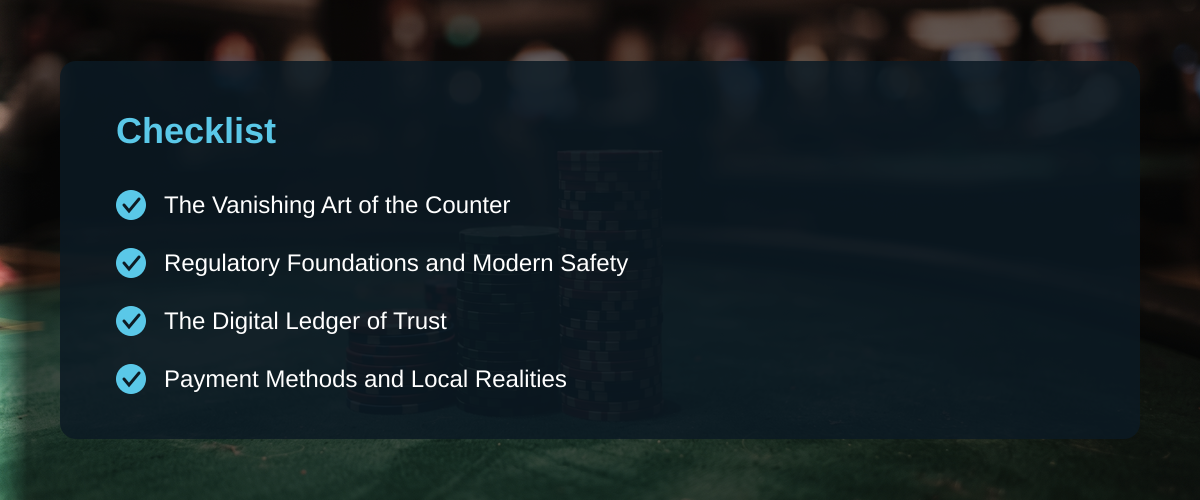
The Vanishing Art of the Counter
There was a certain dignity in the way one approached the betting counter in the eighties and nineties. You had to be prepared, having studied the form in the paper, and you had to speak the language of the shop. Today, that ritual has been replaced by sleek user interfaces and instant buttons, which undoubtedly makes the process smoother, but perhaps a bit less personal. Online casino reviews in the UK often focus on how quickly a site loads or how many games are in the library, which are valid points, but they rarely capture the soul of the experience. What we have gained in speed, we have lost in the slow, deliberate pace of the physical game. However, the online world has introduced a level of transparency that was simply impossible before. You can now see every transaction, every spin, and every win recorded in a digital ledger that never loses a page or smudges the ink.
One of the most significant changes I have noticed is the shift in how we pay for our entertainment. I remember when cash was the only language spoken, and a win meant a thick envelope of notes handed over the counter. Now, we use debit cards, PayPal, and Apple Pay, which offers a level of security that carrying a wad of cash through a rainy car park never could. The Gambling Commission wisely banned credit card gambling back in April 2020, a move that I believe was one of the best things to happen to the industry. It forced a return to the principle of playing with what you actually have, much like the old days when you only brought a set amount of coins to the arcade. The integration of services like Paysafecard also allows for that bit of tangible control, letting you buy a voucher and keep your digital spending strictly separated from your main bank account.
Regulatory Foundations and Modern Safety
The framework that holds this whole digital edifice together is the Gambling Act 2005, which remains the bedrock of British gambling law. It is the reason we can trust that the games aren't rigged and that our money is safe. The Gambling Commission describes itself as the body that licenses, regulates, and provides guidance, and they take this role incredibly seriously. To hold a licence, operators must adhere to the Licence Conditions and Codes of Practice, commonly known as the LCCP. The version effective from 29 July 2026 is a testament to how the rules are constantly evolving to keep up with new technology. These rules aren't just bureaucratic red tape; they are the digital equivalent of the stern-faced inspector who used to visit the local shops to make sure everything was above board.
One of the more recent developments that has caught my eye is the introduction of mandatory stake limits on online slots. As of 9 April 2025, a £5 limit was placed on all adults, while younger players aged 18 to 24 have a £2 limit that went live on 21 May 2025. In the old days, a high-stakes slot machine was a rare beast, usually tucked away in a high-end club, but the internet brought those high limits into every living room. Bringing them back down to sensible levels feels like a return to the spirit of the game, where the thrill came from the play rather than the sheer size of the risk. It is an acknowledgment that while we want to enjoy ourselves, the environment should not encourage excess. This balance is something the regulator strives for, ensuring the market remains healthy for everyone involved.
The Digital Ledger of Trust
When I browse through modern platforms, I am often impressed by the sheer depth of the information available to the player. Unlike the old days where you might have to take a bookie’s word for it, every remote gambling site must now comply with strict age and identity verification rules before a single bet can be placed. This prevents the kind of underage drifting that sometimes happened in the corners of older establishments. The introduction of GAMSTOP has provided a national safety net that never existed in the past. If a person feels they are losing their grip on the fun, they can self-exclude across all licensed websites in one go. It is a powerful tool that shows how far we have come in terms of social responsibility, moving away from the "every man for himself" attitude that sometimes plagued the industry years ago.
The sheer variety of tools available to a modern player is something I would have loved to have decades ago. Features like reality checks, which pop up to remind you how long you have been playing, or deposit limits that you set yourself, are like having a sensible friend sitting on your shoulder. They provide a level of self-governance that was previously only possible for those with the strongest will. The statistics for the year to March 2025 show that the total customer-facing Gross Gambling Yield in Great Britain was £16.8 billion, a sum that represents a lot of people enjoying their favourite pastime. The fact that online gambling, including remote casino, betting, and bingo, grew by 13.1% shows that players are increasingly comfortable with these digital environments because they know the safety net is there.
Payment Methods and Local Realities
In the United Kingdom, we have a very specific way of doing things, and the way we handle our money in casinos is no different. The dominance of the debit card remains, but the rise of e-wallets has added a layer of privacy and speed that is hard to beat. I remember waiting for a cheque to clear in the post after a particularly good week; now, a withdrawal to a PayPal account can often be processed in a matter of hours. This immediacy is a double-edged sword, of course, but for the disciplined player, it is a magnificent convenience. Even Apple Pay has become a staple, allowing for a level of biometric security that makes the old leather wallet look like a relic from the Stone Age. We also have the benefit of not being taxed on our winnings, a long-standing tradition in Great Britain that remains one of the few areas where the taxman leaves us in peace.
While I occasionally miss the physical act of handing over a crisp ten-pound note, the security of modern methods is a fair trade. Using a Paysafecard, for example, feels a little bit like the old way of doing things—you go to a shop, you exchange cash for a voucher, and you use that voucher to play. It bridges the gap between the physical and digital worlds in a way that feels very natural to someone of my generation. It also serves as a natural barrier to overspending, as once the voucher is gone, you have to physically get up and go to the shop again to get another one. That small bit of friction is often all that is needed to keep the game in perspective, much like the walk between two different betting shops in the old days.
The Rhythm of the Modern Game
The games themselves have undergone a transformation that is quite beautiful to behold. The slots of my youth were simple affairs with three reels and a few cherries or bells. Now, they are cinematic experiences with complex stories and orchestral scores. However, the underlying mechanics are still governed by the same principles of chance that I learned decades ago. The regulator ensures that these games are fair, and the LCCP requirements mean that the operators cannot hide the odds in fine print. Whether you are following the horse racing at Cheltenham or waiting for the results of a Saturday afternoon football accumulator, the tension is the same as it ever was. The digital screen hasn't dimmed the excitement of a last-minute goal or a photo finish; it has just made it more accessible.
What I find most interesting is how the community has shifted. We no longer stand around a communal television in a shop, but we participate in live dealer games where we can chat with the croupier and other players from across the country. It is a different kind of socialising, one that is perhaps less intimate but far more expansive. The "remote casino" experience has managed to recreate a surprisingly large amount of the atmosphere of a physical table, right down to the sound of the ball rattling in the roulette wheel. It is a testament to human ingenuity that we have managed to translate the clatter and clinking of a real casino into something that can be experienced through a pair of headphones while sitting in a favourite armchair.
A Reflection on Change
As I look back on the journey from the smoke-filled rooms of the past to the high-definition displays of the present, I am struck by how the essentials have stayed the same despite the scenery changing. The thrill of the win and the sting of the loss are human constants. The British market remains one of the most sophisticated in the world, largely because we have a regulator that isn't afraid to step in and adjust the rules when necessary. The Gambling Commission’s data for 2026 shows a thriving industry, but more importantly, it shows an industry that is being steered towards sustainability. We are no longer just punters; we are customers with rights, protected by law and supported by technology.
The shift to digital has certainly taken away some of the grit and character of the old ways. There was a certain poetry in the way a betting shop smelled on a rainy Tuesday, a mix of damp coats and hope. But in exchange, we have gained a level of safety, variety, and convenience that my younger self would have thought was science fiction. We can set our own boundaries, choose from thousands of different experiences, and know that if we ever need to take a break, the system is designed to help us do so. The £5 stake limit, the ban on credit cards, and the presence of GAMSTOP are not restrictions on our freedom; they are the guardrails that keep the path safe for everyone.
The heart of British gambling has always been about the sport and the spirit of the game. Whether we are placing a bet on the Grand National or trying our luck at a digital blackjack table, we are participating in a tradition that stretches back centuries. The tools have changed, and the speed has increased, but the reason we play remains the same. We enjoy the challenge, the unpredictability, and the small chance of a story to tell at the end of the day. As long as we keep that spirit alive while respecting the rules that keep us safe, the future of the game looks as bright as the neon lights of a vintage arcade! It is a journey worth taking, even if we occasionally look back at the old high street with a bit of a sigh.
Choosing a place to play is a personal decision, but it should always be informed by a look at the protections offered. The best experiences are found where the operator respects the LCCP and treats the player with the fairness they deserve. The digital world is vast, but by staying within the regulated space of the United Kingdom, we ensure that the game remains exactly what it was always meant to be—a bit of fun and a fair crack at the whip. The pencils may be gone, but the thrill of the bet is here to stay!